

How to Price Your Apparel Products for Profit
Setting the prices for your clothing line is one of the most important choices you'll ever make as a brand owner. It's not enough to just cover your costs; you also need to think about how to market your brand, draw in customers, and make money in the long run. A price tag tells a story: it shows how much something is worth, sets expectations, and shapes how people see your brand. A lot of designers rush into making things with great creative ideas but no clear pricing plan, only to find out later that their margins are too small or their products are priced way too low. To run a successful fashion business, you need to know how to set prices that make money while also keeping in mind your brand strategy. As a leading custom clothing manufacturer with over 24 years of experience, UNIT-100 has supported countless startups and brands in refining their pricing-here’s our expert-backed guide to help you nail it.
Step 1: Know Your Real Costs
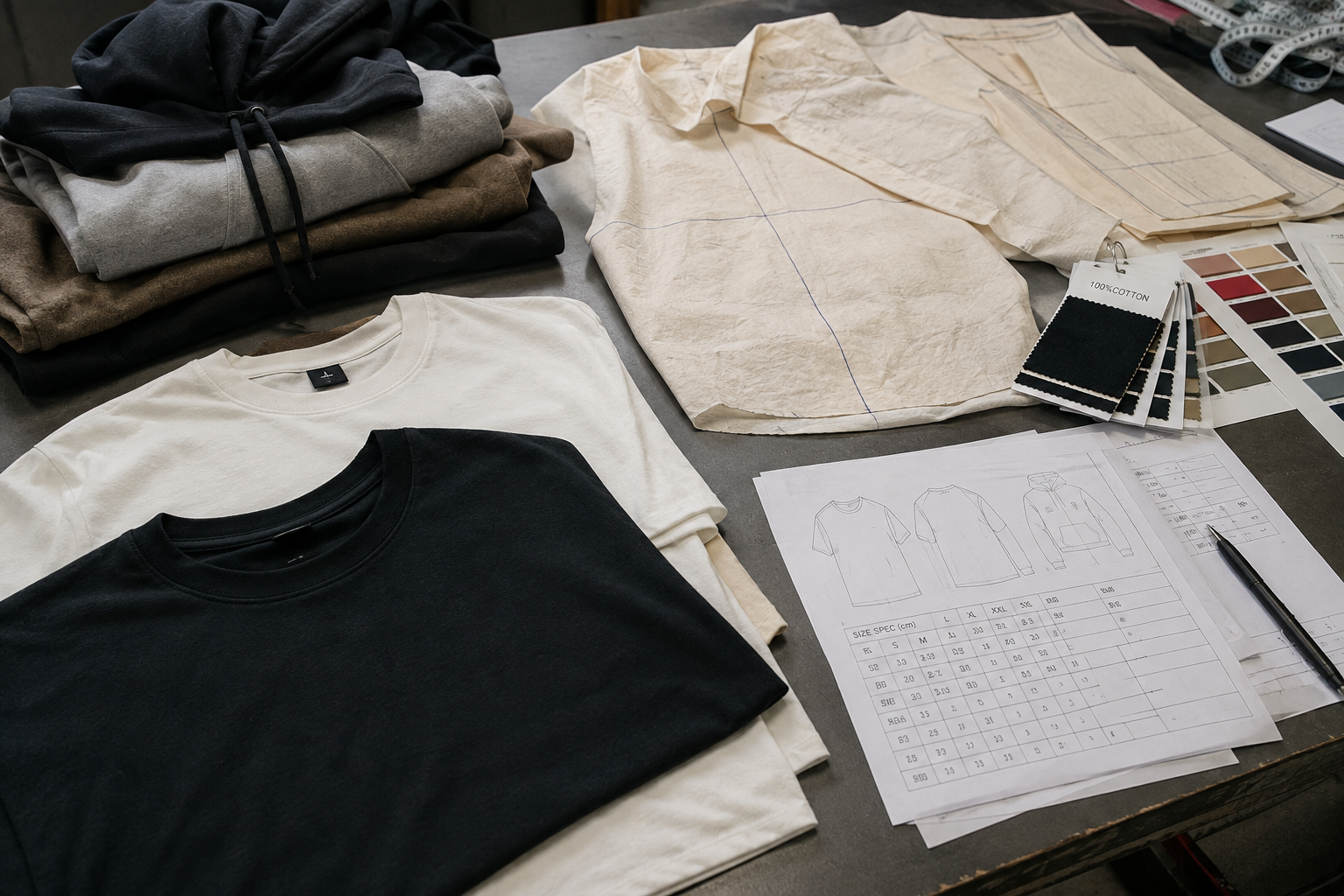
The foundation of smart pricing is a complete understanding of your costs. Too often, new apparel businesses think only about the manufacturing quote, forgetting that every product involves dozens of small, hidden expenses. Start by listing out all your direct costs-materials, trims, labeling, printing, embroidery, packaging, and factory labor. Then include indirect costs such as sampling, photography, website hosting, logistics, warehousing, and even transaction fees from online stores. Every little cost adds up, and ignoring them can make what seems like a profitable product actually lose money.
At UNIT-100, we help brands avoid cost miscalculations by providing transparent, all-inclusive manufacturing quotes. We break down costs for customizations (from screen printing to 3D embroidery) and packaging (branded labels, eco-friendly boxes, etc.) upfront, so there are no surprise expenses. We also recommend adding a 10–15% buffer for fluctuating raw material or shipping rates-our years of supply chain experience have taught us to anticipate these variables, and we pass that insight to our clients. Having an exact unit cost gives you control, and control gives you confidence.
Step 2: Choose a Pricing Model That Fits Your Brand
Depending on their goals and who they are, different clothing brands use different ways to set prices. Keystone pricing is the simplest way to set a price. You just double your production cost to get your retail price. This works for regular clothes where there is a lot of competition, but it might not show how much people think high-end or niche streetwear is worth. On the other hand, premium pricing sets a higher markup-usually three or four times your cost-to show off the quality, design, and craftsmanship of the item. Value-based pricing is when you set the price based on how much your ideal customer is willing to pay, not just how much it costs you to make it. For example, streetwear brands tend to use value-based models because their customers are willing to pay for identity and stories as well as fabric and stitching.
The key is consistency: your prices should align with your marketing, visuals, and customer service. UNIT-100 helps brands match their pricing model to their offerings-for instance, if you’re using our premium organic fabrics or 3D embroidery, we’ll advise a premium pricing structure to reflect that quality. For startups using our small-batch production (MOQ starting at 50 pieces), keystone or value-based pricing often works best to balance accessibility and profitability.
Step 3: Research Your Market and Understand Your Audience
Your prices won't work if they don't make sense for the people you want to sell to, even if you know your costs and profits. It's important to do research. Look at brands that are in the same niche as you, have the same level of quality, and target the same audience. If your T-shirts cost $25 and similar ones from competitors cost $45, your product might seem worse even if it is well-made. On the other hand, charging too much without a clear brand story can turn off customers who don't yet know how valuable you are.
Think about what your audience values: affordability, exclusivity, or sustainability. UNIT-100 supports this by offering customizable options that align with customer priorities - for eco-conscious audiences, we provide certified organic fabrics and eco-friendly packaging, which you can leverage to justify a higher price. For B2B clients like schools or businesses, we emphasize our reliable in-house production and 4-stage quality check, making cost-effectiveness and consistency the focus of their pricing strategy. Knowing your audience lets you set prices that attract the right customers, not just any customers.
Step 4: Calculate Your Margin and Test the Numbers
Once you've decided how you'll price your products, figure out what your expected margins will be. A good rule of thumb is to keep your margins at least 60-70% for retail and 30-50% for wholesale. These margins not only cover costs, but they also leave room for promotions, partnerships with influencers, and reinvesting in the brand. Before you launch, try out different price points on paper. For example, see how a $45 T-shirt and a $55 T-shirt affect your expected sales and total profit. A small price increase can sometimes make a big difference in margins without changing the number of sales.
UNIT-100 helps clients refine these numbers by sharing industry benchmarks from our 50 million+ produced garments. We also advise on how production volume affects costs-for example, scaling from 100 to 500 pieces with us can lower unit costs by 15-20%, allowing you to either increase margins or keep prices competitive. Use spreadsheets or pricing calculators to model scenarios-pricing is both math and behavioral science, and finding the sweet spot between profitability and fairness is key.
Step 5: Review and Adjust Over Time
Pricing isn't set in stone; it changes as your brand grows, your audience changes, and your supply chain changes. Keep an eye on how quickly your bestsellers sell out. If they do, your prices might be too low. If things don't sell even when they're on sale, think about changing the design, the season, or the price. Customer perceptions of value change with the seasons, inflation, and new competitors. Check your data every few months and make changes as needed. Be honest with your audience when you raise prices. Honesty builds trust, even when prices go up.
UNIT-100 helps with this by giving regular updates on production costs and market trends. If, for instance, the price of raw materials goes up, we'll let you know right away so you can change your prices ahead of time. We also help brands change direction. If a design tested through small-batch DTG printing becomes popular, switching to screen printing with us lowers unit costs, so you can keep your margins or pass the savings on to your customers.
Common Mistakes to Avoid
● Printing fuzzy pictures from low-resolution files(UNIT-100 offers free design file checks to prevent this).
● Selecting fabric that doesn't fit the function, like heavy cotton for summer uniforms.
● Designs that are too complicated and lose detail when they are printed.
● Not paying attention to how things fit and shrink when they are washed.
● Making quick decisions without checking the evidence.
Conclusion and Call to Action
To make money selling clothes, you need to do a lot of things, like keep track of your costs, do market research, and know your audience. It's not just about the numbers; it's also about making sure the price matches the value your brand offers. With UNIT-100 as your partner, you get more than just a manufacturer. You also get 24 years of experience in the industry to help you set prices that will help your business grow.
We can help you with everything from making a small batch of custom t-shirts to scaling up a whole collection. We can help you with everything from clear cost breakdowns and fabric customization to sampling and bulk production. Are you ready to set prices that will help your business? Call us today for a free consultation, and let's make your idea into a profitable line that your audience will love.




 You Can Find Us Here
 Room 5/F-11,Block A Wantong International Square Liwan District,Guangzhou.
Quick Links
Services

Founded in 2001, UNIT-100 is a custom clothing manufacturer, specializing in high-quality T-shirts, hoodies, and other knitwear.