


Many clothing brands ask for heavier fabric because they want the product to feel more premium. A 260 GSM T-shirt feels more substantial than a thin basic tee. A 420 GSM hoodie feels more serious than a light sweatshirt. For streetwear, that weight can be part of the brand identity.
But fabric weight does not only affect hand feel. It also affects production cost, carton weight, shipping method, freight estimate, and final landed cost. A garment that looks affordable at the unit price stage can become less competitive after packing and shipping are added.
This is especially important for small and medium custom apparel orders. A first 100-piece order, a hoodie drop, or a matching hoodie and sweatpants set may be shipped by express or air freight. In that case, both actual weight and carton size can change the final cost.
Quick Answer
Fabric weight affects final apparel pricing because heavier fabric usually increases garment weight, carton gross weight, freight cost, and sometimes duty or handling cost. But shipping cost is not based only on real weight. For express and air shipments, carton size can also create dimensional weight, which may become the chargeable weight.
Before confirming a custom apparel order, brands should track at least 10 data points: fabric GSM, estimated garment weight, order quantity, pieces per carton, carton size, actual carton weight, dimensional weight, chargeable weight, shipping method, and final landed cost.
The safest approach is to check weight and carton data before bulk production finishes, not after the goods are already packed.
Why Fabric Weight Matters Beyond Quality
Brands often talk about fabric weight as a product-quality decision. That is true, but it is only part of the story.
A 300 GSM oversized T-shirt may feel better than a 180 GSM basic tee, but it also uses more fabric and weighs more per piece. A 450 GSM hoodie may feel premium, but the carton becomes heavier and larger. A matching hoodie and sweatpants set can look like one product online, but for shipping it may behave like a much heavier order.
This matters when the brand calculates profit. If the product cost is checked without shipping, duty, taxes, packing, and local delivery, the margin may look better than it really is.
Factory Note: A heavier garment can improve perceived quality, but the brand should check whether the final landed cost still supports the retail price.
Shipping and Pricing Data Brands Should Track
Shipping cost becomes easier to understand when the brand and factory track the same data before the goods leave the factory. Unit price alone is not enough.
| Data Point | What to Check | Why It Matters |
|---|---|---|
| Fabric GSM | Example: 180 GSM, 240 GSM, 360 GSM, 500 GSM | GSM affects fabric cost, garment weight, structure, and shipping weight. |
| Garment Weight | Weight per piece after sewing and finishing | Helps estimate total order weight before packing. |
| Order Quantity | 100 pcs, 300 pcs, 500 pcs, or more | Changes production efficiency, packing quantity, and freight planning. |
| Pieces Per Carton | How many garments fit safely in one carton | Affects carton count, carton size, and shipping chargeable weight. |
| Carton Size | Length × width × height | Used to calculate dimensional weight for many express and air shipments. |
| Actual Carton Weight | Gross weight after garments, poly bags, labels, and carton are packed | Actual weight is still important, especially for heavy garments. |
| Dimensional Weight | Carton volume converted into billable weight | Large cartons can cost more even if the goods are not very heavy. |
| Chargeable Weight | Usually the higher of actual weight and dimensional weight | This is the weight many carriers use for pricing. |
| Shipping Method | Express, air freight, sea freight, DDP, FOB, or warehouse delivery | Different routes have different cost, timeline, and risk. |
| Landed Cost | Product cost + packing + freight + duty + taxes + local delivery | Shows the real cost before retail markup. |
| Reorder Packing Record | Carton size, carton weight, pieces per carton, packing method | Helps estimate future reorders faster and more accurately. |
For a small test order, exact shipping cost may only be confirmed after packing. But the factory can still estimate the likely risk by checking garment weight, carton size, and packing method early.
GSM and Garment Weight
GSM means grams per square meter. It tells how heavy the fabric is before it becomes a garment. A higher GSM usually means heavier fabric, but the final garment weight also depends on pattern size, fit, cutting, trims, rib, hood, pocket, waistband, and washing.
A 240 GSM T-shirt and a 300 GSM T-shirt may not sound very different on paper, but for a 100-piece order, the difference can become visible in both carton weight and freight cost.
| Fabric Weight Direction | Common Use | Shipping Impact |
|---|---|---|
| 160–180 GSM | Lightweight T-shirts | Lower actual weight, but carton volume still matters. |
| 180–220 GSM | Standard T-shirts | Balanced for everyday custom T-shirt orders. |
| 240–320 GSM | Heavyweight T-shirts and oversized tees | Higher actual weight and usually higher freight pressure. |
| 320–400 GSM | Standard hoodies and sweatshirts | Noticeably heavier per piece; packing plan becomes more important. |
| 400–500+ GSM | Heavyweight hoodies and premium streetwear | Higher actual weight, larger cartons, and stronger landed cost impact. |
Factory Note: GSM is not only a fabric-quality number. It is also the first clue for estimating garment weight and shipping pressure.
Typical Garment Weight Differences
Each garment type behaves differently. A T-shirt is usually easier to pack densely. A hoodie takes more space because of the hood, rib, pocket, thickness, and folding volume. Sweatpants may not feel as bulky as hoodies, but waistband and leg length still add volume.
| Garment Type | Common Weight Risk | What to Check |
|---|---|---|
| Light T-shirt | Low actual weight but may still create carton volume | Pieces per carton and carton dimensions. |
| Heavyweight T-shirt | Higher actual weight and thicker folding height | Garment weight and carton gross weight. |
| Standard Hoodie | Hood and fleece add weight and volume | Pieces per carton, carton size, actual weight. |
| Heavyweight Hoodie | High actual weight and large carton volume | Chargeable weight and shipping method. |
| Sweatpants | Waistband, length, and cuff affect folding volume | Folded size and set packing method. |
| Hoodie + Sweatpants Set | Both actual weight and volume rise quickly | Set packing, carton ratio, and landed cost. |
For brands, this means a hoodie order and a T-shirt order should not be compared only by unit price. The shipping behavior is different.
Carton Packing and Pieces Per Carton
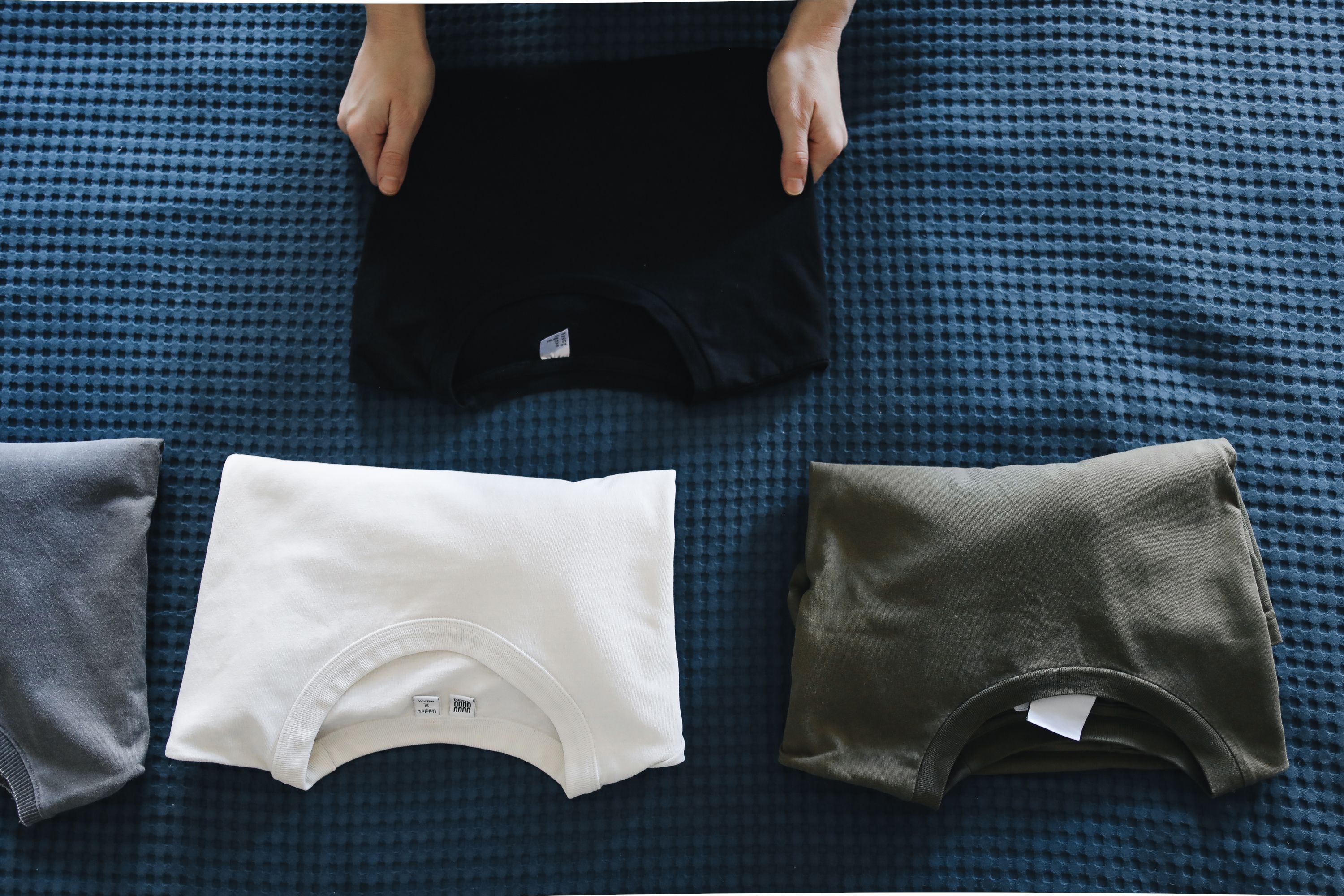
Packing decides how much space the order uses. A factory may fold garments tightly, pack each garment in a poly bag, add hang tags, add size stickers, then place a fixed number of pieces into each carton.
If the garment is thick, the carton may fill up before it reaches a high actual weight. In that case, dimensional weight may become more important. If the garment is dense and heavy, actual weight may become the main cost driver.
| Packing Data | Why It Matters |
|---|---|
| Folded garment size | Controls how many pieces can fit in one carton. |
| Poly bag type | Thicker or oversized bags increase carton volume. |
| Hang tag and packaging | Retail packaging can add bulk and handling time. |
| Pieces per carton | Affects carton count and freight estimate. |
| Carton gross weight | Used to check actual weight. |
| Carton dimensions | Used to calculate dimensional weight. |
Factory Note: A neat packing method is not only about presentation. It can also help control carton size and chargeable weight.
Actual Weight vs Dimensional Weight
Shipping companies often compare actual weight and dimensional weight. Actual weight is what the carton weighs on a scale. Dimensional weight is calculated from the carton size.
For many express shipments measured in centimeters and kilograms, dimensional weight can be calculated as:
| Formula | Example | Result |
|---|---|---|
| Length × Width × Height ÷ 5000 | 60 cm × 40 cm × 50 cm ÷ 5000 | 24 kg dimensional weight |
| Chargeable Weight | Actual weight: 18 kg Dimensional weight: 24 kg |
Carrier may charge based on 24 kg |
DHL Express explains volumetric weight using a divisor of 5000 for centimeters and kilograms. FedEx also shows dimensional weight based on package dimensions divided by 5000 in centimeters, or 139 when using inches and pounds. UPS explains that dimensional weight may apply when a package is large relative to its actual weight, with divisors depending on rate type.
Factory Note: Do not only ask for carton gross weight. Ask for carton size as well. A light but bulky carton may still be expensive to ship.
Packing Density and Carton Size
Packing density means how much product fits inside a carton without damaging the garments. It is not always best to pack as tightly as possible. Too much compression can create deep wrinkles, damage puff print, crush embroidery, deform packaging, or affect retail presentation.
But loose packing also creates problems. A carton that is too large for the order may increase dimensional weight. For premium private label products, the factory has to balance shipping efficiency and product presentation.
| Packing Choice | Possible Benefit | Possible Risk |
|---|---|---|
| Tighter folding | Reduces carton volume | May create stronger wrinkles or pressure marks. |
| Larger poly bag | Improves presentation | May increase carton size. |
| More pieces per carton | Reduces carton count | May exceed safe carton weight or crush garments. |
| Fewer pieces per carton | Protects garments better | May increase carton count and freight cost. |
| Set packing | Better for customer delivery | May increase folded volume for hoodie and pants sets. |
Express, Air Freight, and Sea Freight
The right shipping method depends on order size, deadline, destination, budget, and how much risk the brand can accept.
Express can be useful for samples, urgent small orders, and first test drops. Air freight can work for medium orders where speed still matters. Sea freight usually makes more sense for larger orders, but it takes longer and needs better planning.
| Shipping Method | Best For | What to Watch |
|---|---|---|
| Express Courier | Samples, urgent small orders, first drops | Dimensional weight and high cost per kg. |
| Air Freight | Medium orders with launch deadline pressure | Chargeable weight, airport handling, customs clearance. |
| Sea Freight | Larger bulk orders and planned reorders | Longer transit time, port handling, local delivery. |
| DDP Shipping | Brands wanting easier door-to-door planning | Confirm what is included: freight, duties, taxes, local delivery. |
| FOB / EXW | Brands using their own forwarder | Clear pickup point, export terms, and local cost responsibility. |
Factory Note: Shipping should be discussed before the goods are finished. Waiting until packing day can create budget surprises.
Final Landed Cost, Not Just Unit Price
The factory unit price is only one part of the cost. A brand should understand the landed cost before deciding whether a product is profitable.
Landed cost usually includes product cost, sample cost, packing, freight, duty, taxes, customs handling, and local delivery. The exact items depend on the trade terms, destination, and shipping method.
| Cost Area | What It Includes |
|---|---|
| Product Cost | Garment fabric, cutting, sewing, printing, embroidery, washing, labels. |
| Packing Cost | Poly bag, hang tag, barcode sticker, carton, carton mark. |
| Freight Cost | Express, air, sea, DDP, or forwarder quote. |
| Import Cost | Duty, taxes, customs clearance, handling fee. |
| Local Delivery | Port-to-warehouse, courier delivery, warehouse receiving. |
| Reorder Adjustment | Future cost changes from fabric, exchange rate, carton size, and freight route. |
A heavier fabric may support a higher retail price, but the margin only works if the landed cost still makes sense.
Packing QC Before Shipment
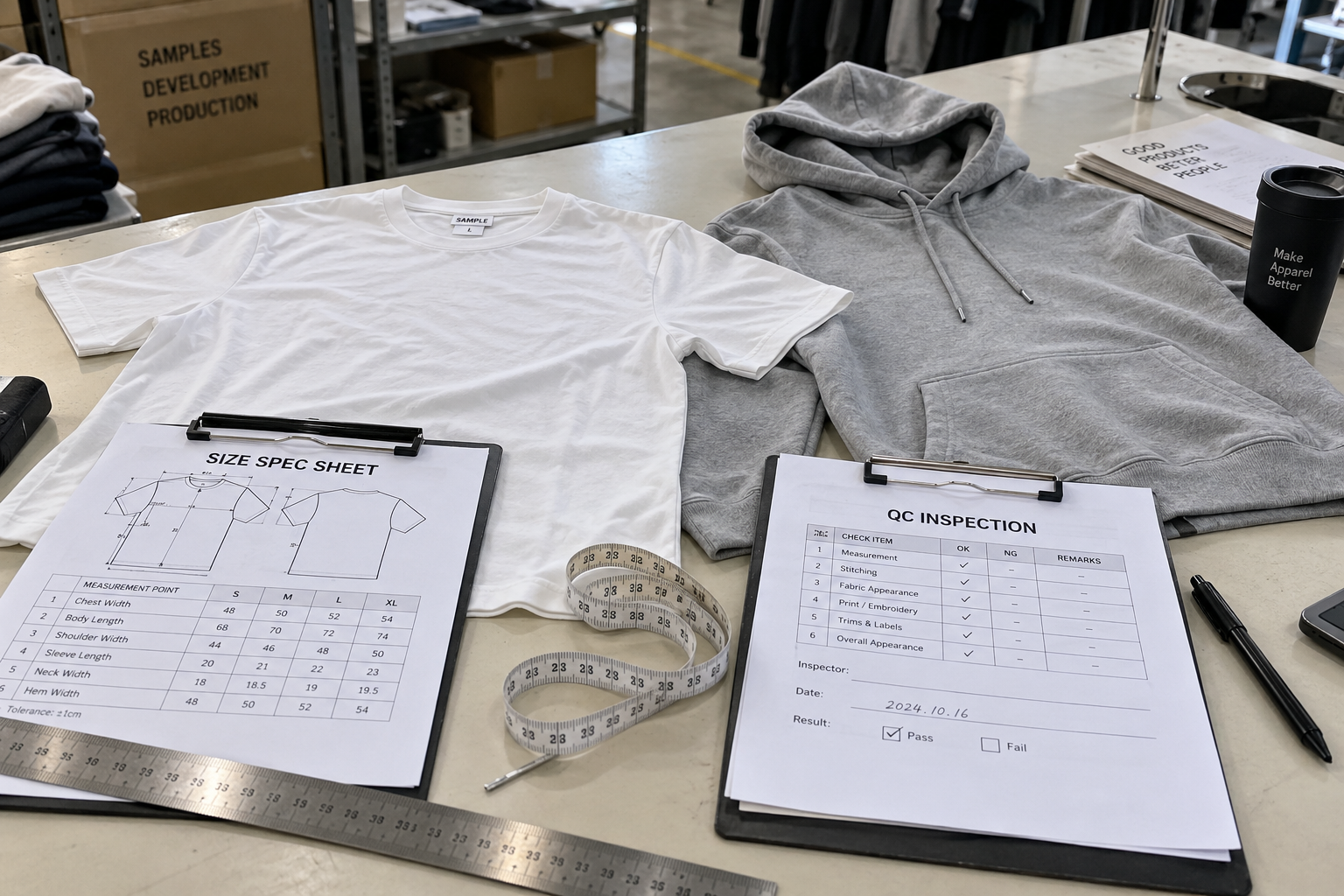
Packing QC helps prevent shipping mistakes. The factory should check size breakdown, color breakdown, pieces per carton, carton gross weight, carton dimensions, carton mark, and packing list before shipment.
This matters more when the order has many sizes, colors, sets, or private label packaging. If the carton mark is wrong or the packing list does not match the goods, the brand may face receiving problems at the warehouse.
| Packing QC Point | What to Check |
|---|---|
| Size and color ratio | Correct quantity by SKU, size, and color. |
| Pieces per carton | Consistent carton quantity and packing method. |
| Carton gross weight | Actual packed carton weight. |
| Carton dimensions | Length, width, height for freight estimate. |
| Carton mark | Style, color, size, quantity, carton number, PO if needed. |
| Packing list | Should match final packed cartons. |
Ask for carton count, carton size, gross weight, packing list, and shipping method. These details help avoid last-minute freight surprises.
Reorder Packing Records
If a brand plans to reorder, the first shipment should create a packing record. This record helps estimate the next order more quickly and keeps packing consistent.
The record should include garment weight, pieces per carton, carton size, carton gross weight, packing method, carton mark, shipping route, and any notes about packing efficiency or product protection.
| Record to Keep | Why It Helps |
|---|---|
| Garment weight | Helps estimate total order weight next time. |
| Carton size | Helps estimate dimensional weight. |
| Carton gross weight | Helps compare actual and chargeable weight. |
| Pieces per carton | Helps repeat packing efficiency. |
| Packing method | Helps maintain product presentation. |
| Shipping method | Helps compare express, air, sea, or DDP options. |
| Freight notes | Records what should be improved in the next shipment. |
Brand Checklist Before Confirming Shipment
Before confirming a custom apparel shipment, brands should check the numbers behind the shipping estimate.
- Confirm fabric GSM and estimated garment weight.
- Check actual garment weight after sampling if possible.
- Confirm order quantity and size breakdown.
- Ask how many pieces will be packed per carton.
- Check carton size: length, width, and height.
- Check carton gross weight after packing.
- Compare actual weight and dimensional weight.
- Ask which weight is used for the freight quote.
- Compare express, air freight, sea freight, or DDP options.
- Calculate landed cost, not only factory unit price.
- Confirm carton marks and packing list before shipment.
- Keep packing records for future reorders.
Best Practice: Do not wait until the order is packed to think about shipping. Fabric weight, carton size, and packing method should be part of the production plan.
Frequently Asked Questions
Does heavier fabric always mean higher shipping cost?
Usually, heavier fabric increases actual garment weight, which can increase freight cost. But shipping cost also depends on carton size, packing density, shipping method, destination, and whether dimensional weight applies.
Why is my hoodie order expensive to ship?
Hoodies are heavier and bulkier than T-shirts. The hood, fleece, rib, pocket, and folding volume can increase both actual weight and carton volume, especially for express or air shipping.
What is chargeable weight?
Chargeable weight is the weight used to calculate shipping cost. For many express and air shipments, the carrier may compare actual weight and dimensional weight, then charge based on the higher number.
Can better packing reduce shipping cost?
Better packing can sometimes reduce carton volume or carton count, but it must not damage the garment, print, embroidery, packaging, or presentation. The goal is balanced packing, not simply over-compressing the goods.
What should I ask the factory before shipping?
Ask for carton count, carton size, gross weight, pieces per carton, packing list, carton mark, shipping method, and whether the freight quote is based on actual weight or dimensional weight.
Sources and References
Conclusion
Fabric weight is not only a quality decision. It affects garment weight, carton packing, shipping method, chargeable weight, and final landed cost.
For custom T-shirts, hoodies, sweatpants, tracksuits, and private label streetwear, brands should check GSM, garment weight, carton size, actual weight, dimensional weight, and packing method before confirming the final shipment.
If your brand is developing heavyweight T-shirts, hoodies, sweatpants, matching sets, or private label apparel, UNIT-100 can help review fabric weight, packing method, carton data, shipping options, and production planning before your order starts.
Related Articles
Do not let shipping surprise your margin.
Talk with UNIT-100 about fabric GSM, garment weight, packing method, carton size, shipping route, and landed cost planning for your next custom apparel order.
Plan Your Custom Apparel Order





 You Can Find Us Here